![Heaader1SourceAccount[3148]](https://sourceaccounting.ca/wp-content/uploads/2021/11/Heaader1SourceAccount3148-2048x289.png)

For many Canadian business owners, tax compliance doesn’t stop with T4 slips. If your corporation pays out dividends, interest, or other types of investment income, you may need to prepare and file a T5 Statement of Investment Income. Issuing T5 slips correctly is essential, not only for your shareholders and lenders, but also to remain compliant with the Canada Revenue Agency (CRA). Below, we walk through the essentials: what a T5 is, when to issue one, deadlines, penalties, and the steps to prepare and file correctly.
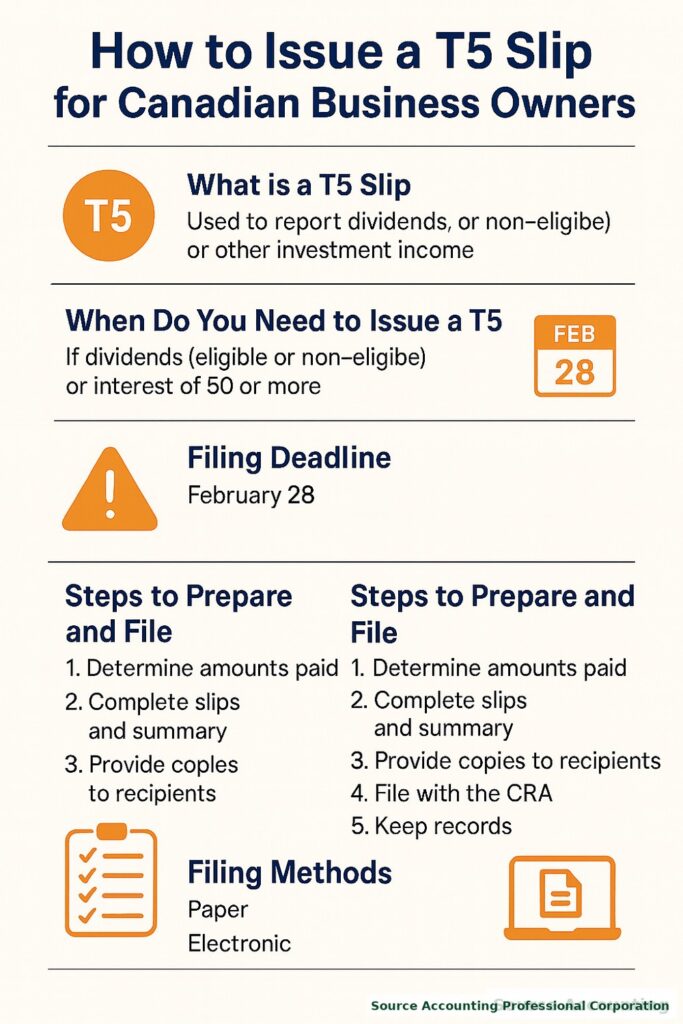
1) What is a T5 Slip? A T5 slip is a tax form used to report investment income paid by a business or financial institution to individuals or corporations. Common examples include:
- Dividends paid to shareholders
- Interest paid on loans from shareholders or others
- Certain royalty payments
- Other investment-type amounts
T5s are accompanied by a T5 Summary, which totals all slips issued by the corporation for the year.
2) When Do You Need to Issue a T5? As a business owner, you must issue a T5 slip if your corporation paid:
- Dividends (eligible or non-eligible) to shareholders
- Interest of $50 or more to any recipient in a calendar year
- Other reportable investment income that falls under CRA’s T5 guidelines
Even if you pay dividends to yourself as a shareholder of your corporation, you are required to issue a T5 slip.
3) Filing Deadline T5 slips and summary must be filed with the CRA by the last day of February following the calendar year in which the income was paid. For example: Dividends paid in 2025 must be reported on T5 slips filed by February 28, 2026 (last day of February). Recipients must also receive their copy of the slip by the same deadline.
4) Penalties and Interest for Late or Non-Filing The CRA imposes strict penalties if you fail to file T5 slips on time: Late filing penalties:
- 1 to 5 slips: $10 per day (minimum $100, maximum $1,000)
- 6 to 10 slips: $15 per day (minimum $100, maximum $1,500)
- 11 to 50 slips: $25 per day (minimum $250, maximum $2,500)
- More than 50 slips: higher penalty brackets apply
Interest charges apply to any unpaid amounts related to T5 filings. The CRA may also assess penalties for false or misleading information.
5) Key Boxes and Information on a T5 Slip Some of the most commonly used boxes on a T5 include:
- Box 10 – Actual amount of dividends (other than eligible dividends)
- Box 11 – Taxable amount of dividends (other than eligible dividends)
- Box 12 – Dividend tax credit for eligible dividends (other than eligible dividends)
- Box 13 – Interest from Canadian sources
- Box 18 – Capital gains dividends (only if you are a mutual fund corporation (or similar) designating a capital gains dividend under the Income Tax Act)
- Box 24 – Actual amount of dividends eligible
- Box 25 – Taxable amount of eligible dividends
- Box 26 – Dividend tax credit for eligible dividends
Not every box is relevant to all corporations—only complete the sections that apply.
6) Filing Requirements When issuing T5 slips, you must:
- Prepare three copies: one for the recipient, one for the CRA, and one for your records.
- File electronically if you are submitting more than 5 slips.
- File either electronically (preferred) or on paper (if under 5 slips).
- Include a T5 Summary with the total amounts reported on all slips.
7) Steps to Prepare and File T5 Slips and Summary Here’s a step-by-step approach for small and medium-sized business owners:
- Determine amounts paid – Review dividends or interest paid in the year.
- Download CRA forms – Use the official T5 slip and T5 summary forms (fillable PDFs are available on CRA’s website).
- Complete the slips – Enter recipient information (name, SIN or BN, address) and the amounts paid.
- Complete the T5 summary – Total all slips for the year.
- Provide copies to recipients – Deliver recipient copies by February 28.
- File with the CRA – Submit the slips and summary electronically through CRA’s Internet File Transfer or Web Forms, or by mail if eligible.
- Keep records – Retain copies in your corporate records for at least 6 years in case of CRA review or audit.
8) Filing Methods The CRA provides two main ways to file T5 slips and the T5 Summary: A) Electronic Filing (Preferred and Mandatory if More Than 5 Slips):
- Use CRA’s Web Forms or Internet File Transfer (XML format) through the CRA website.
- Electronic filing is faster, reduces errors, and provides immediate confirmation of submission.
- Corporations issuing more than 5 slips in a calendar year must file electronically.
B) Paper Filing (Only if 1 to 5 Slips):
- If you have 5 or fewer slips, you may submit paper forms.
- You must use CRA’s official pre-printed forms (ordered from CRA) or laser-printed versions generated from certified software.
- Completed slips and the summary must be mailed to the tax centre listed in the CRA instructions.
Important Notes:
- If you are required to file electronically but submit paper forms, CRA can assess a penalty of $100 to $2,500 depending on the number of slips.
- Always retain a copy of your filing confirmation (electronic or mailed) in your corporate records for at least 6 years in case of CRA audit
9) T5 Slip Filing Checklist for Canadian Business Owners Use this quick checklist to ensure you meet CRA requirements when issuing T5 slips and the T5 Summary. This is a simplified guide for business owners and should be used alongside professional tax advice.
☑ Determine if a T5 is required (dividends, interest ≥ $50, or other investment income).
☑ Gather recipient information (full name, SIN or BN, address). ☑ Calculate total dividends or interest paid in the year.
☑ Complete T5 slips for each recipient (only fill in applicable boxes).
☑ Complete the T5 Summary with totals from all slips.
☑ Provide recipient copies by February 28.
☑ File with CRA by February 28 (mandatory electronic filing if >5 slips).
☑ Choose filing method: CRA Web Forms, Internet File Transfer, or paper (if ≤5 slips).
☑ Retain copies of slips and summary in corporate records for at least 6 years.
☑ Review accuracy—errors may result in CRA penalties or reassessments.
Conclusion: Issuing a T5 slip may seem straightforward, but accuracy is critical. Mistakes can result in penalties and cause issues for your shareholders when they file their own tax returns. If you’re unsure whether you need to issue a T5, how to classify dividends as eligible vs. non-eligible, or how to file correctly, it’s best to consult a Chartered Professional Accountant (CPA). At Source Accounting, we assist business owners across Ontario with year-end planning, dividend strategies, and compliance with CRA filing requirements.
Tax Planning Experts for High-Net-Worth Families and Medical Professionals in Mississauga and Toronto – Source Accounting Professional Corporation is a trusted CPA firm in Mississauga, serving professionals and business owners across the GTA—including Toronto, Brampton, Oakville, Milton, and Etobicoke. We offer specialized tax planning for doctors, dentists, nurses, pharmacists, consultants, and realtors, helping you reduce taxes through income splitting strategies and wealth transfer planning. 📞 Call 647-930-8130 to schedule a consultation with an experienced tax advisor.
Disclaimer: The above contents are provided for general guidance only, based on information believed to be accurate and complete, but we cannot guarantee its accuracy or completeness. It does not provide legal advice, nor can it or should it be relied upon. Please contact/consult a qualified tax professional specific to your case.