![Heaader1SourceAccount[3148]](https://sourceaccounting.ca/wp-content/uploads/2021/11/Heaader1SourceAccount3148-2048x289.png)
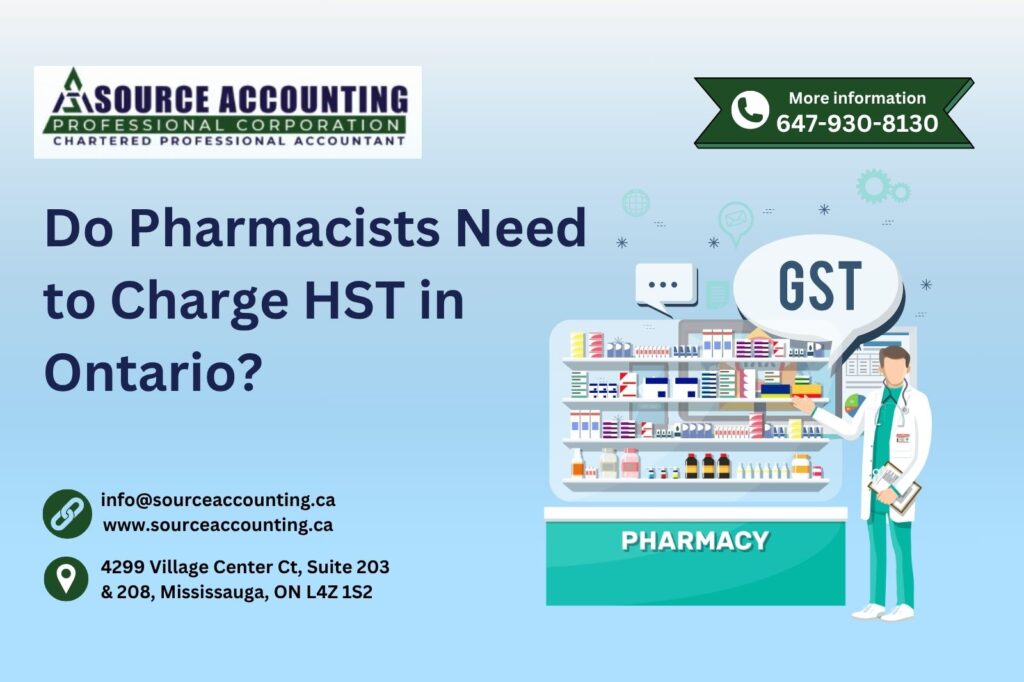
Pharmacists working as independent contractors often wonder if their services are subject to HST. This article explains how CRA classifies pharmacy services, what counts as exempt healthcare supply, and when HST registration becomes mandatory.
Across Ontario, more pharmacists are working as independent contractors or incorporated professionals, offering relief or consulting services to pharmacies, hospitals, and healthcare organizations. But one question comes up repeatedly - should a pharmacist contractor charge HST/GST?
The answer depends on the nature of the services provided and who the client is. Here's a clear summary based on CRA guidance and how it applies to pharmacists in Mississauga, Toronto, Brampton, Oakville, Milton, and other parts of the GTA.
Understanding How HST Applies to Health-Care Professionals
In Ontario, the Harmonized Sales Tax (HST) is charged at 13% on most goods and services. However, under Part II of Schedule V of the Excise Tax Act, certain health-care services are exempt, meaning HST does not apply.
CRA defines exempt health-care services as those intended to maintain health, prevent disease, or treat illness, when performed by a regulated health-care professional such as a pharmacist. However, not all work performed by a pharmacist automatically qualifies for exemption. The purpose and context of the service matter.
CRA Reference:
- Excise Tax Act, Schedule V, Part II, Section 7.3 (https://laws-lois.justice.gc.ca/eng/acts/e-15/page-121.html)
- CRA Policy P-256 – Qualifying Health-Care Supplies (https://www.canada.ca/en/revenue-agency/services/forms-publications/publications/p-256/qualifying-health-care-supplies-application-gst-hst-supplies-medical-examinations-assessments-reports-certificates.html)
When Pharmacist Services Are Exempt from HST
If you are a licensed pharmacist providing traditional pharmacy services such as dispensing prescriptions, providing patient counselling, or performing medication reviews or injections, your services are generally considered 'pharmacy services rendered by a pharmacist' and are exempt from HST/GST.
This is true whether you are working directly for a community pharmacy, under contract with a hospital, or through your own corporation as a relief or locum pharmacist.
When Pharmacist Services Are Subject to HST
If you provide services that are not primarily for patient care, the exemption no longer applies. For example, HST must generally be charged if you provide consulting or administrative services, training, or management/advisory services. In these situations, you are providing a business or professional service, which is taxable at 13% HST in Ontario.
CRA confirms in Policy P-256 that the main purpose of the service determines whether it is exempt.
Employment vs. Independent Contractor - Why It Matters
If you are an employee, you never charge HST. But if you are an independent contractor, CRA looks at your contract and working relationship to determine if you are in business for yourself.
CRA considers factors such as control, ownership of tools, and financial risk. If CRA concludes that you are self-employed, then you must determine whether your services are exempt (health-care) or taxable (consulting/business).
Common Mistakes Pharmacist Contractors Make
1. Assuming all pharmacy services are automatically exempt
Many contractors think that being a licensed pharmacist automatically makes their work HST-exempt, even when they perform administrative or consulting work that is taxable.
2. Failing to register for HST after crossing the $30,000 small supplier threshold
Once your total taxable revenues exceed this limit in a 12-month period, registration is mandatory.
3. Mixing taxable and exempt revenue without tracking separately
This often leads to under- or over-collecting HST, creating issues during CRA reviews.
4. Claiming input tax credits (ITCs) on exempt income
You cannot claim ITCs on expenses related to exempt health-care services.
5. Issuing invoices that don't clearly indicate HST treatment
Invoices should clearly state whether HST is charged or not, and display your HST number when applicable.
6. Providing services under the wrong business structure
Some pharmacists operate personally instead of through a corporation, or vice versa, without understanding the impact on HST registration and liability.
7. Not keeping proper documentation for mixed work
When part of your work is exempt and part is taxable, CRA may ask for detailed records of how each service was classified.
Frequently Asked Questions
If your total taxable revenues are less than $30,000 over four consecutive quarters, you are not required to register for HST. However, you can still chose to register voluntarily.
Yes, your corporation becomes the service provider, and the same HST rules apply.
No. CRA rules do not allow charging HST on exempt supplies.
Many pharmacists wear multiple hats — for example, working shifts in a community pharmacy (exempt) while also providing consulting services to a long-term care home or a business client (taxable). In such cases, CRA requires you to track each type of revenue separately and apply HST only to the taxable portion.
You can claim input tax credits (ITCs) only for expenses directly related to your taxable work, not for exempt pharmacy services. If your bookkeeping system or invoices don't clearly separate these categories, CRA may deny ITCs or reassess your filings. It's best to set up separate tracking or work with an accountant to ensure proper categorization and compliance.
Review your contract and service type. CRA Policy P‑256 provides the test for determining this.
How Source Accounting Helps Pharmacists and Healthcare Professionals
At Source Accounting Professional Corporation, we work with pharmacists, physicians, and other healthcare professionals across Mississauga, Toronto, Brampton, Oakville, and the Greater Toronto Area to navigate complex GST/HST, incorporation, and tax planning matters.
We help clients assess whether their services are taxable or exempt, set up proper invoicing, track revenue correctly, and structure their professional corporations for optimal tax efficiency.
If you're unsure whether your services should be subject to HST, or you're considering incorporating your pharmacy practice, Source Accounting can guide you through every step.
The above contents are provided for general guidance only, based on information believed to be accurate and complete, but we cannot guarantee its accuracy or completeness. It does not provide legal advice, nor can it or should it be relied upon. Please contact/consult a qualified tax professional specific to your case.
At Source Accounting Professional Corporation, we help incorporated professionals and business owners across Mississauga, Toronto, Brampton, Oakville, Milton, and the GTA choose, set up, and manage accounting systems that work for their business. Whether you're using QuickBooks Online, migrating from Wave or Xero, or looking to improve your financial reporting and CRA compliance, our team of QuickBooks Advanced ProAdvisors ensures your books stay accurate, automated, and tax-ready year-round.